Persian Gifts for Kids: Which Book for Which Child (2026 Guide)
Looking for a Persian or Iranian gift for a child? Seven books, each built on a real archaeological find in Iran. Which one to pick for the kid who draws flipbooks, the kid who just started an instrument, and the kid who still carries one particular toy everywhere.
There are seven Tiny Time Traveler books in print, and the honest truth is that the best one is whichever one is closest to what a particular child is already obsessed with.
So this is not a ranking. It is a matching exercise. Find the kid you are buying for, and the book is right there.
All seven are for ages 3 to 12 — read aloud at the younger end, read alone at the older end. Every one of them starts from something real that came out of the ground in Iran.
Buying for a Persian or Iranian Family?
This is the question we get most at this time of year, usually from one of two people: someone shopping for friends whose family is Iranian, and parents who want their own children to hold on to where they come from.
Either way, the series was written for exactly that. These are not books about Iran written from the outside. Every one is set at a real archaeological site on the Iranian Plateau, researched and written by an archaeologist who has worked at them — and the children in the stories are an Iranian-American brother and sister, which is the part young readers tend to notice first.
Three things worth knowing before you buy:
- Book One is published in Persian as well as English. The Persian edition is sold through Sherkat Ketab, and it is the obvious gift for a Farsi-speaking household or a grandparent who would rather read it in their own language.
- The Girl Who Had Two Languages is the one to pick for a diaspora kid. It is about a girl who cannot work out whether she is American or Iranian, and it does not resolve that by making her choose.
- None of it needs prior knowledge. A child with no connection to Iran gets an adventure story about a 5,200-year-old cartoon. That is the point: it works as a gift either way.
For the kid who draws flipbooks in the corner of their homework
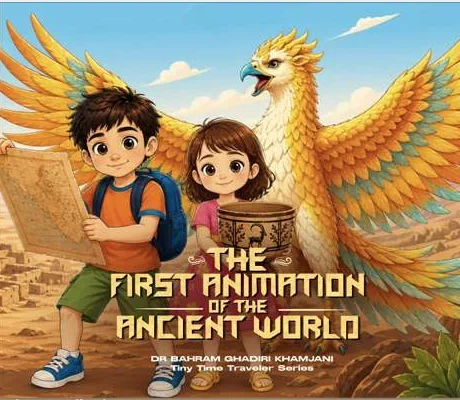
The First Animation of the Ancient World — Book One
At Shahr-e Sukhteh, the Burnt City, archaeologists dug up a clay goblet about the size of a coffee mug. Five pictures are painted around its rim: a goat, a tree. Spin it, and the goat jumps up to eat the leaves.
It is over 5,200 years old, and it is the oldest known animation in the world. Not a device, not a trick — a person, five thousand years ago, working out how to make a drawing move.
If you are buying one book in the series and have no other information to go on, buy this one.
For the kid who just started an instrument
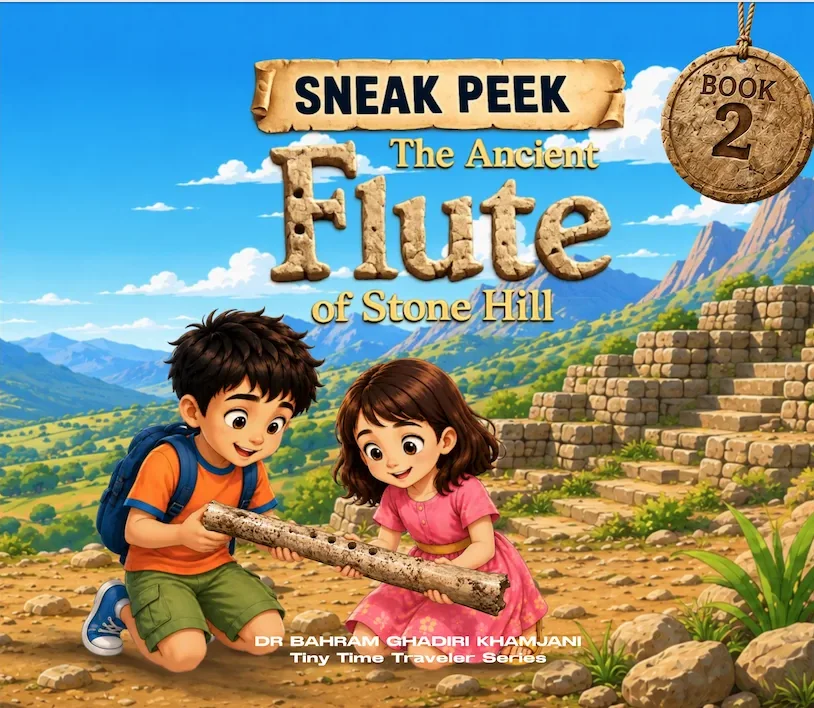
The Ancient Flute of Stone Hill — Book Two
Aryan hears a flute from his school music room and decides he has to learn to play it. Which takes him back 8,000 years, to a village where someone had already worked out how to make a flute from the leg bone of a bird.
Good for the child three weeks into recorder lessons, when the novelty is wearing off and nobody in the house is enjoying it.
For the kid who still carries one particular toy everywhere
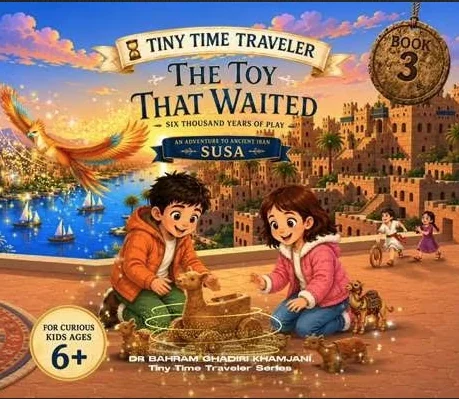
The Toy That Waited — Book Three
In ancient Susa, a child shaped a small animal out of clay roughly 6,000 years ago. Archaeologists keep finding them: little horses pulling carts with wheels that turn, miniature dishes, tiny figures of people. Some of the Susa pieces are in the Louvre now.
Not a palace, not a crown. A parent making something small so a child would have something to play with. The youngest readers get this one immediately.
For the kid who wants to know how things are made
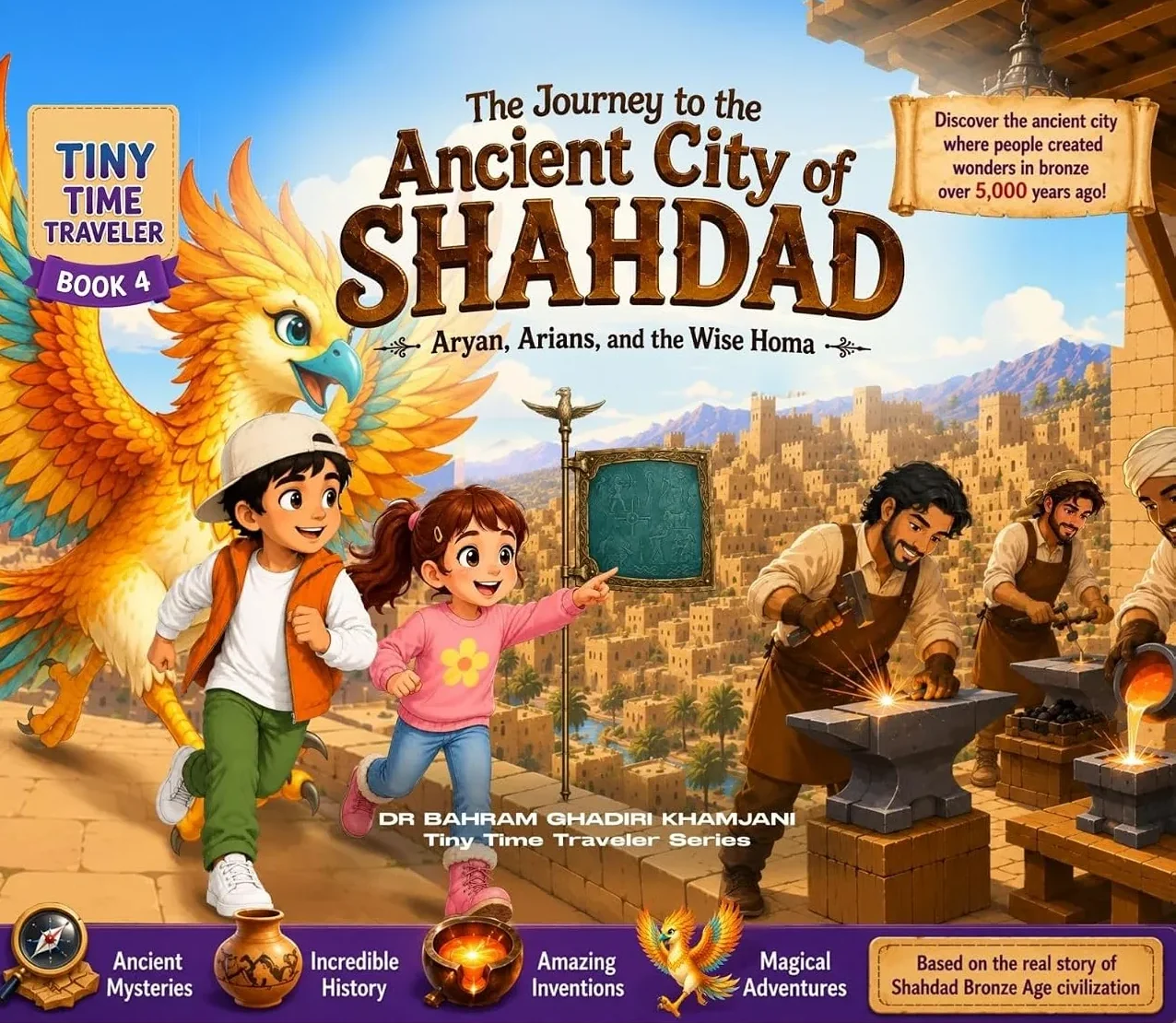
The Journey to the Ancient City of Shahdad — Book Four
Shahdad sat at the edge of the Lut Desert, one of the hottest and driest places on earth, and it was a working city more than 5,000 years ago. Its people found water, dug channels to carry it, grew food in sand, and then got very good at metal — melting copper out of rock and hammering it into tools, mirrors and cups.
The find everyone remembers is a flag made of metal, more than 4,000 years old, one of the oldest known anywhere. Standing on top of it is a bird with its wings open.
For the kid with clay under their fingernails
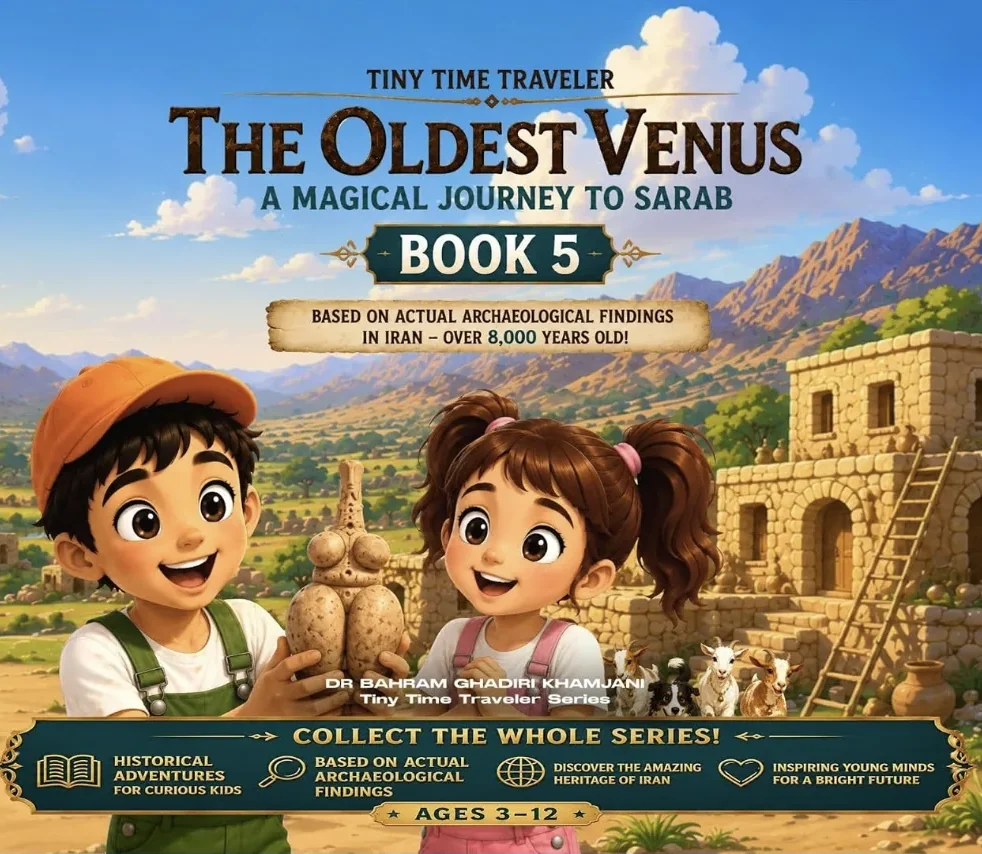
The Oldest Venus: A Magical Journey to Sarab — Book Five
Eight thousand years ago, in a Neolithic village called Sarab in the Kermanshah region, somebody sat down with a lump of clay and made a figure of a woman. She survived. She is one of the oldest known figurines in the world, and she is called the Venus of Sarab.
For the child who is always making something and always being told to wash their hands.
For the kid who is growing up in two languages
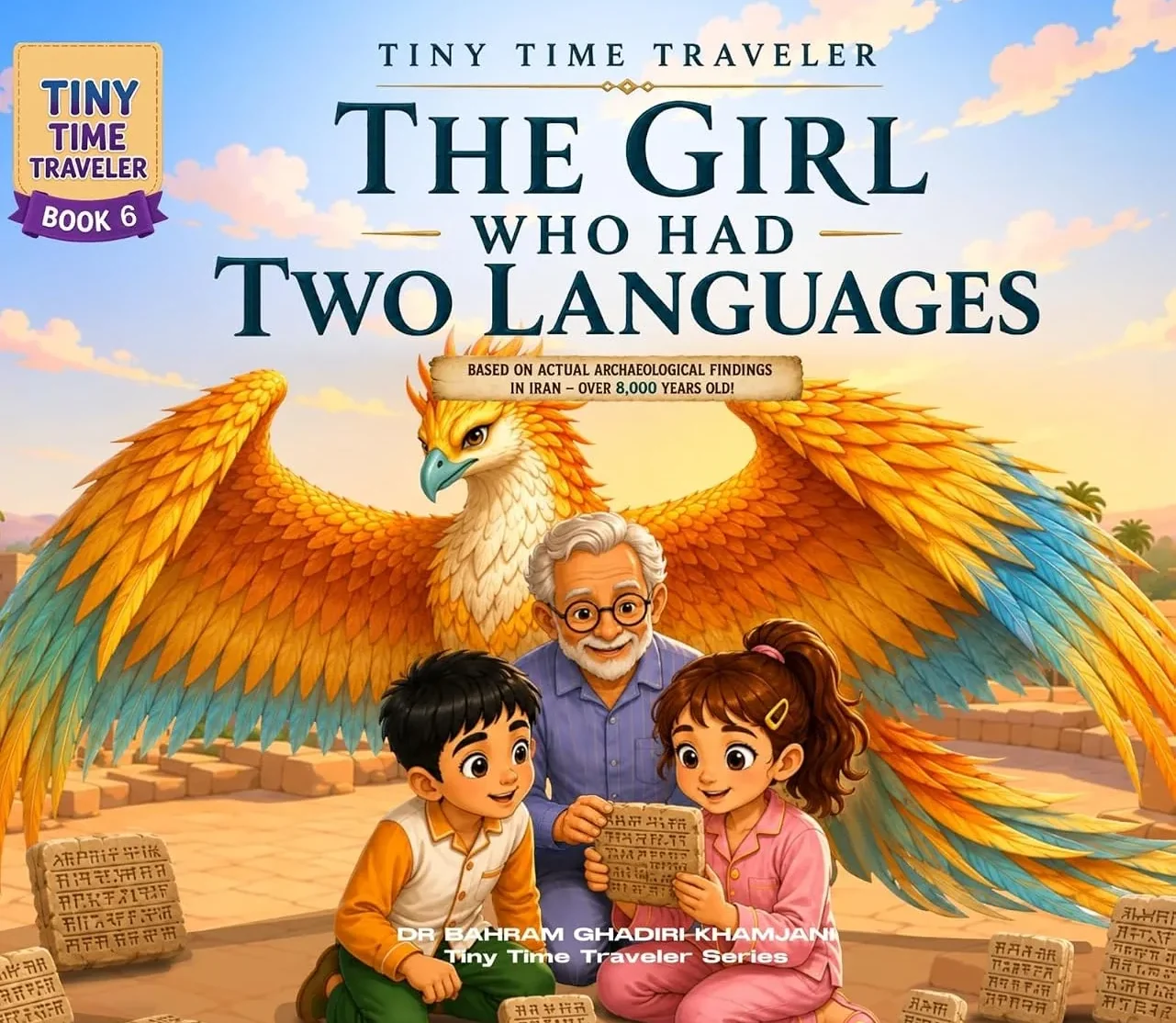
The Girl Who Had Two Languages — Book Six
The night before her first day at a new school, Ariana cannot sleep, because she cannot work out whether she is American or Iranian. Homa carries her back to ancient Susa, where she meets a girl who speaks two languages and cannot imagine why anyone would think that was a problem.
Susa was chosen deliberately. It was a city where different languages lived side by side for thousands of years. A child with two languages is not an exception to history. For most of history, she was history.
This is the one that gets bought for cousins, and the one grandparents tend to pick up without being asked.
For the kid in the school band
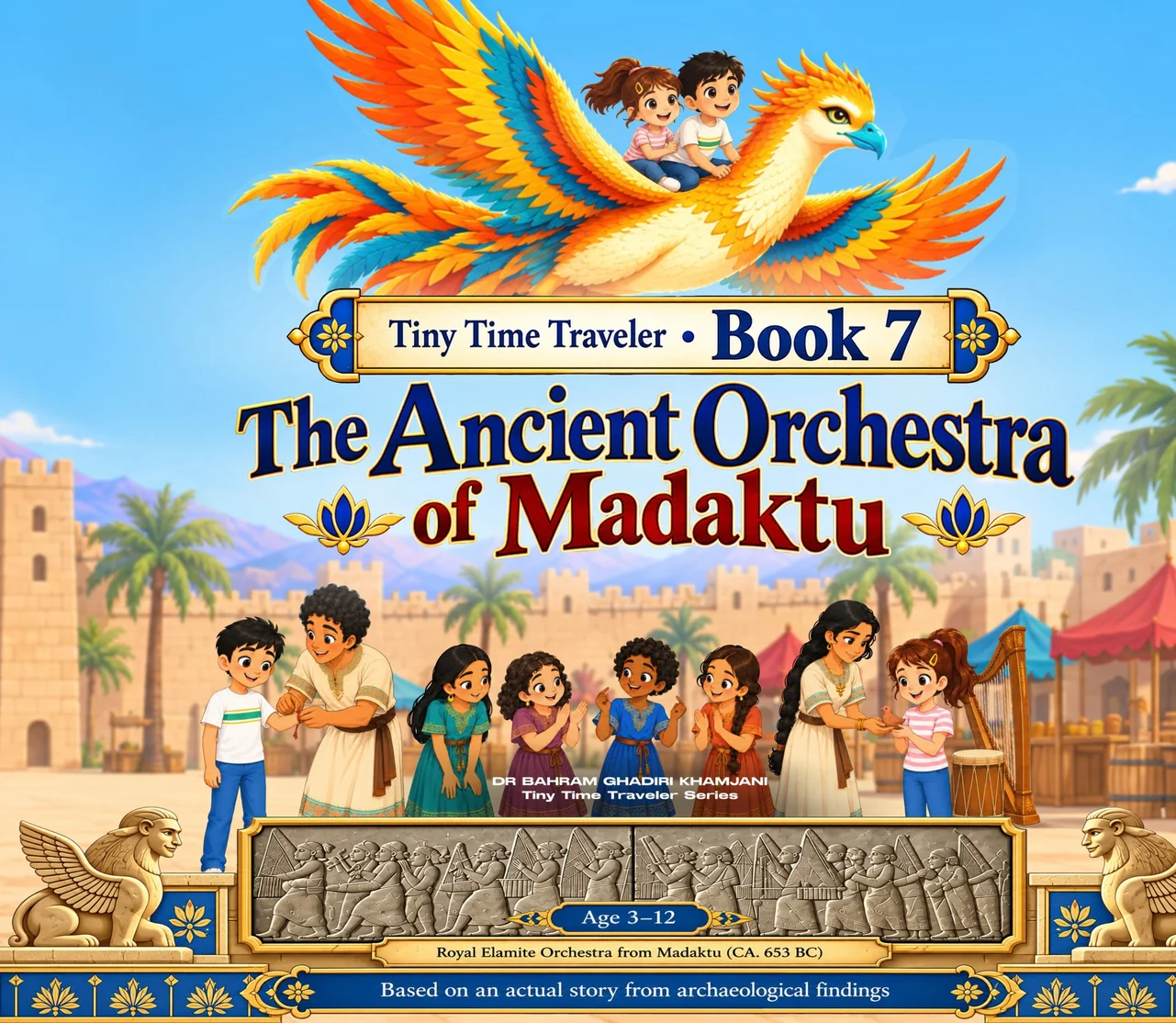
The Ancient Orchestra of Madaktu — Book Seven
Twenty-six musicians, 2,600 years ago, walking in a royal procession with harps, pipes and drums. We know this because it is carved on a palace relief from Nineveh showing the royal Elamite orchestra of Madaktu, from around 653 BC — one of the clearest records we have of professional musicians working together in Iran before the Achaemenid Empire.
Book Seven is the newest, and it is print only for now. Everything else in the series is available on Kindle as well.
A Few Practical Notes
Buying the set. Every published book sits on one Amazon page, where you can take the full Kindle set in a single click or pick up the hardcovers and paperbacks together.
Getting one signed. Dr. Bahram Ghadiri is at the Super Holiday Boutique on Saturday, December 5 in Pleasant Hill and Sunday, December 6 in Concord — free admission, free parking, indoors. Tell him who the book is for and how old they are and he will write to that child by name.
For a Persian-speaking family. Book One is also available in Persian.
For a classroom or library. Schools and libraries get 15% on bulk orders, and the classroom packs — maps, activities, discussion questions — are free to download whether you buy anything or not.
Ordering late. Print editions come from a printer rather than a warehouse down the road, so the week of December 15 is about the last comfortable moment. After that, Kindle.
For the kid who already has them all. Books Eight and Nine — Ganj Dareh and Tepe Yahya — are on the way. Both have sneak-peek pages, which make a reasonable thing to show a child who has read everything else.
One more thing worth saying, since it is the season for it: a book is a gift you can open over and over again. The second reading is the one that counts.